Oblong Industries is the developer of the g-speak spatial operating environment.

The SOE's combination of gestural i/o, recombinant networking, and real-world pixels brings the first major step in computer interface since 1984; starting today, g-speak will fundamentally change the way people use machines at work, in the living room, in conference rooms, in vehicles. The g-speak platform is a complete application development and execution environment that redresses the dire constriction of human intent imposed by traditional GUIs. Its idiom of spatial immediacy and information responsive to real-world geometry enables a necessary new kind of work: data-intensive, embodied, real-time, predicated on universal human expertise.

Some of the SOE's core ideas are already familiar from the film Minority Report, whose characters performed forensic analysis using massive, gesturally driven displays. The similarity is no coincidence: one of Oblong's founders served as science advisor to Minority Report and based the design of those scenes directly on his earlier work at MIT. Other foundational components are less directly visible but as crucially transformative. The g-speak platform braids development arcs begun in the early 1990s at MIT's Media Laboratory, where Oblong's principals produced radical user interface advances, distributed and networked language designs, and media manipulation technologies.

From academia; into popular cinema; and out broadly into the world as commercial product: it's an unordinary path for technical thought and effort, but one -- leading to g-speak -- that seems now logical and even necessary. The people who work in Oblong's Los Angeles and Barcelona laboratory offices are as concerned with design as with programming, with humanist principles as with running a company. Synthesizing these concerns is the only way to insure that the metamorphosis of human-computer interaction we offer the world will be one of beauty and durable worth.

horizontal rule

carlton sparrell speaks at mit

Carlton Sparrell, Oblong's VP of Product Development, spoke at the MIT Media Laboratory's Fall 2009 Sponsor Week meeting.

Over the course of the twenty minute talk (viewable via the video above) Carlton furnishes the first public overview of the technical capabilities of plasma, Oblong's rewindably networked framework for data self-description, encapsulation, and interprocess transport.

Carlton also provides a glimpse of a 'common operating environment' built atop plasma and g-speak. This new environment enables collaborative work at multiple levels: (1) application sharing and control; (2) input-output coordination; and (3) data synchronization. The video that he shows -- a video-within-video, as you view it overhead -- involves an air-traffic analysis scenario.

For the record, Carlton's work in gestural interface is the earliest (at Oblong): as far back as the first few years of the 1990s, he was building systems like ICONIC at MIT. Here's some documentation of that work; more is available by searching the world wide web.  read more...

g-speak at RISD, fall 2009

Amber Frid-Jimenez and Kelly Dobson are teaching a g-speak lab at Rhode Island School of Design again this semester. We're excited to see what another class of designers and artists do with g-speak. We count ourselves really lucky to have the opportunity work with so many great people at RISD, MIT and USC.

Last semester saw experiments in sculpture, textile pattern design, projection on furniture and fabric, and new glove (and not-so-glove) designs.

So far this year there are experiments in story telling, gestural etiquette, dance, spatial form making, and digital pottery. The images below link through to videos on youtube.

  read more...

g-speak + TMG

Jamie Zigelbaum and other researchers at MIT's Media Laboratory, working together with Professor Hiroshi Ishii in the Tangible Media Group, are pursuing a line of research they characterize as 'body, object, space, screen, and surface':

... today pixels are cheap and computers are fast -- after 40 years we are almost ready to move past the mouse. With new gestural interfaces like g-speak [3] we can create digital environments that are nearly seamless with architectural space. We can create hybrid spaces where groups of people can interact with digital objects, physical objects, and each other using a shared physical language that is both legible and scalable.

One early instantiation of these ideas is the g-stalt interface:

  read more...

oblong at altitude: sundance 2009

A cadre of Oblong personnel is even now on (strictly speaking, in a special gallery under) the ground in Park City, Utah, where we've deployed TAMPER at the 2009 Sundance Film Festival. The TAMPER installation is a giddy example of the sort of image and media manipulation tools we've built g-speak to enable.

Our Sundance guests -- who already number in the thousands -- find the experience exhilarating. A few grim cinephiles have supplementally raised an eyebrow (one per cinephile) at the filmic heresy that TAMPER provides: a fluid new ability to isolate, manipulate, and juxtapose (rudely, say the grim) disparate elements (ripped from some of the greatest works of cinema, continue the grim). For us, what's important is the style of work: real-time manipulation of media elements at a finer granularity than has previously been customary or, for the most part, possible; and a distinctly visceral, dynamic, and geometric mode of interaction that's hugely intuitive because the incorporeal suddenly now reacts just like bits of the corporeal world always have. Also, it's glasses-foggingly fun.

Subsequent posts will likely detail the installation's software architecture, but for the present consult TAMPER's youtube channel for video documentation of our Sundance engagement.

read more...

science fact

Over the past 30 years I've had a series of powerful moments with computers that profoundly shaped my perspective on technology. The first was as a 12 year old when my Uncle Charlie took me into the data center for Frito Lay in 1977, handed me a big black APL book, and sat me down in front of a computer terminal. Another was when Raj Bhargava, Matt Cutler, Eric Richard, and Mathew Gray hovered around me in front of a Project Athena computer in the MIT Student Center in 1994 and showed me Freshman Fishwrap and Wandex running on a very early version of Mosiac. The most recent happened two years ago when I walked into Oblong's lab in downtown Los Angeles and John Underkoffler slipped some gloves onto my hands.  read more...

g-speak in slices

A capsule history of modern computing might look something like so:

  • the batch processing age.
  • development of interactive systems: teletypes; time-sharing; terminals. the rise of the command line.
  • transition to graphical user interfaces. character-mode and bitmapped applications. the personal computer. the spread and standardization of mouse-driven, two-dimensional window systems.
  • networks. tcp/ip and udp in use almost everywhere.

That's a history from the perspective of adoption,   read more...

origins: arriving here

Here you are.

You are Oblong. There are different ways to count, and depending how you do it you are two and a half years old; or you are four years old; or almost fifteen; or you're a quarter century; or you appear to have been born on 13 November 2008. You have many parts, and ideas have arrived from all over the place to build you, but there are some central strands too. Go back.

1.   It's about 1994. Part of you is pursuing a new line of research at the MIT Media Laboratory, trying to make information more literally spatial. Your feeling is that, ten years in,   read more...

commercial overview: platform and products

The Spatial Operating Environment

Oblong Industries is the developer of the g-speak spatial operating environment.

The SOE's combination of gestural i/o, recombinant networking, and real-world pixels offers the first major step in computer interface since 1984.

Oblong helps clients deploy SOE-based solutions to real-world problems, including:

  • analysis of large data sets
  • operation of three-dimensional interfaces
  • construction of efficient multi-user collaborative applications
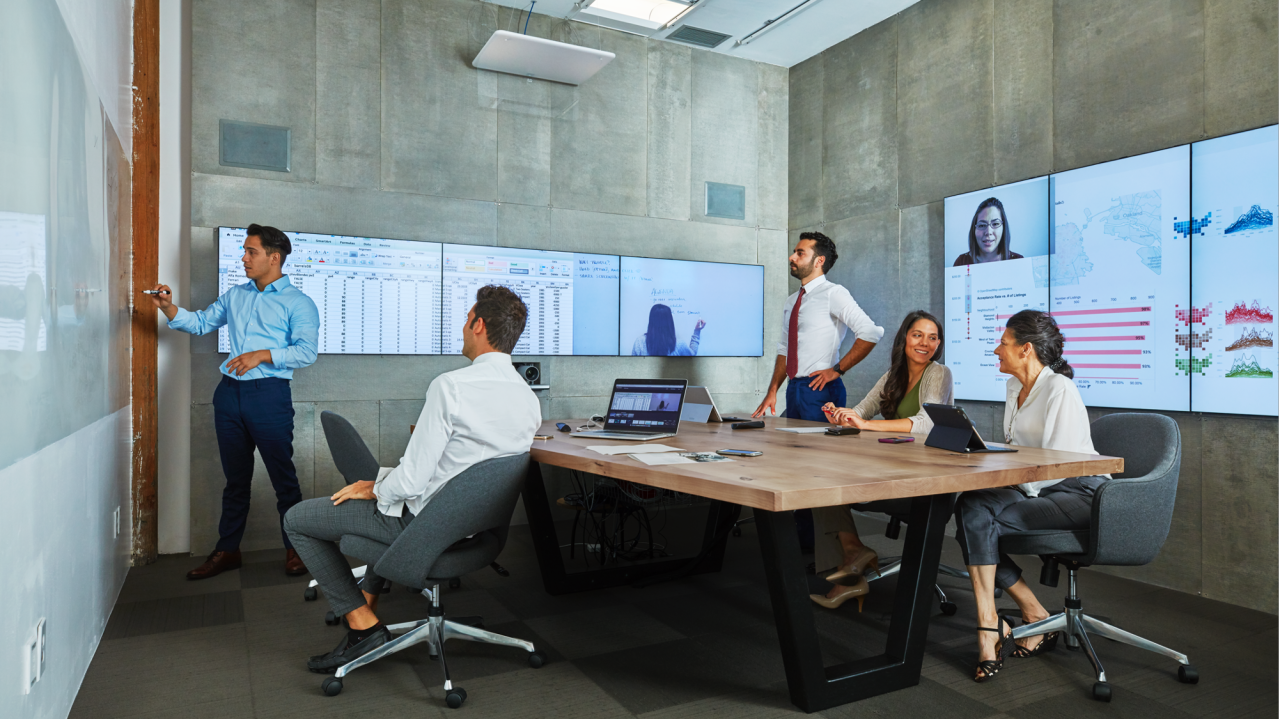
  • integration of large screens and multiple computers into room- and building-scale work environments
  • development of large-scale applications that run interactively across enterprise networks

read more...